Hotel management question
How to Read a Hotel P&L Without Jumping to the Wrong Cause
A practitioner-led guide to reading a hotel P&L by operating driver, flexing costs to actual activity, separating cost behaviour, and turning controllable variances into management action.
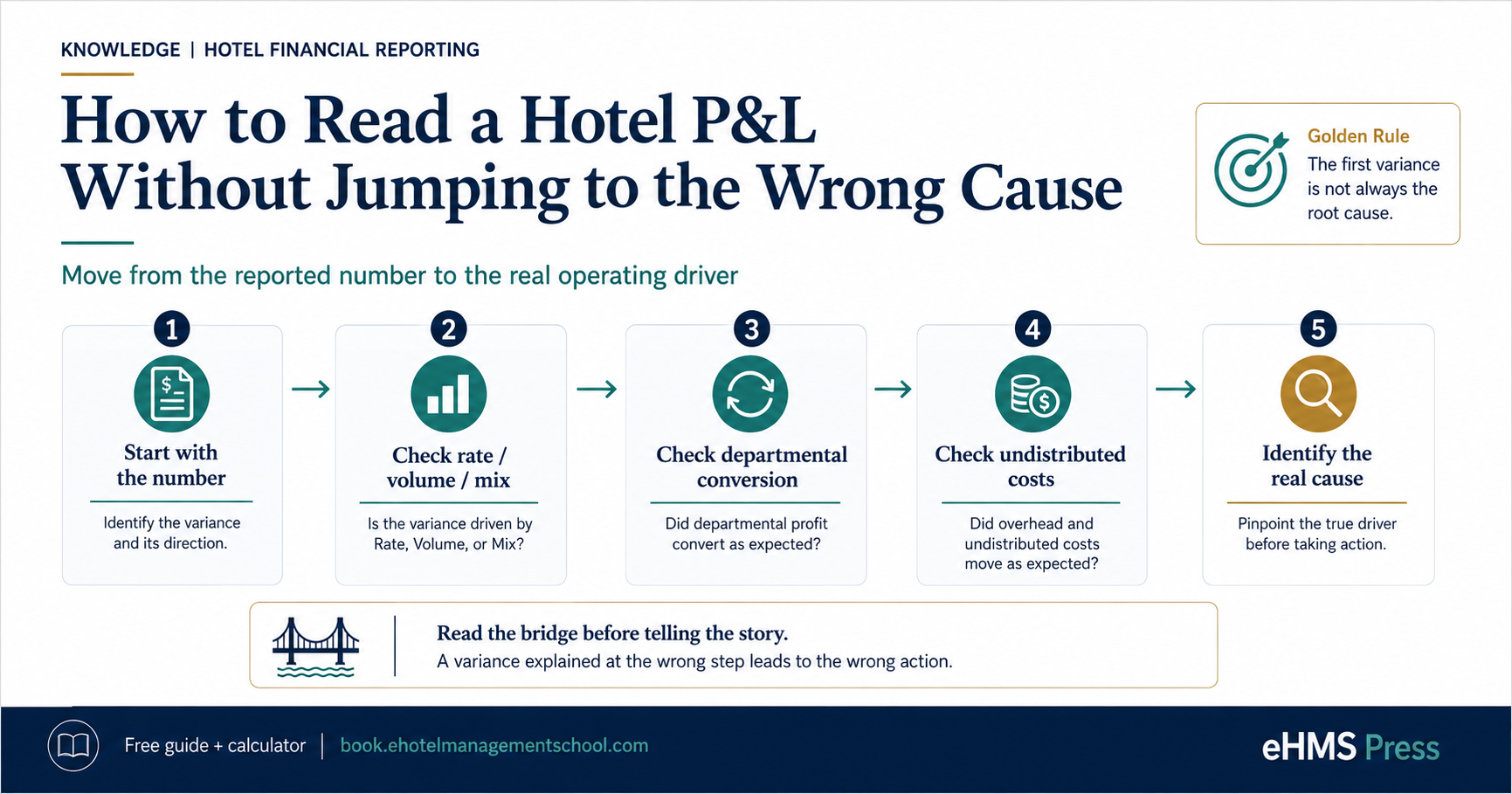
A hotel P&L should not be read as a narration of figures from top to bottom. It should be read as a diagnostic tool. Start with the reported variance, flex the expected cost to the actual operating level, separate fixed and variable behavior, test price and mix, identify the controllable movement, and finish with a named action, owner and review point.
Direct answer. A hotel P&L should not be reviewed by simply narrating actual, budget, and variance figures. Start with the material movement, flex the expected cost to the actual operating level, separate fixed and variable cost behaviour, test price and mix, isolate the controllable movement, and finish with a specific action, owner, and review point.
I have sat through a large number of hotel P&L reviews over the years, and there is one habit I continue to see. Someone opens the P&L at the top, reads Revenue, then Rooms, F&B, payroll, operating expenses, and eventually GOP. For each line, they tell us whether the number is above or below budget and provide some commentary.
Technically, the P&L has been reviewed. But very often, I still do not know what actually moved, why it moved, whether the movement was reasonable, and what management is going to do about it. That is the difference, for me, between reading a P&L and narrating a P&L.
Don't explain the variance. Bridge it.
The framework below summarizes the discipline I try to apply: move from the reported variance to the actual operating level, understand how the cost should behave, separate rate and mix effects, isolate the controllable movement, and close with action and ownership.
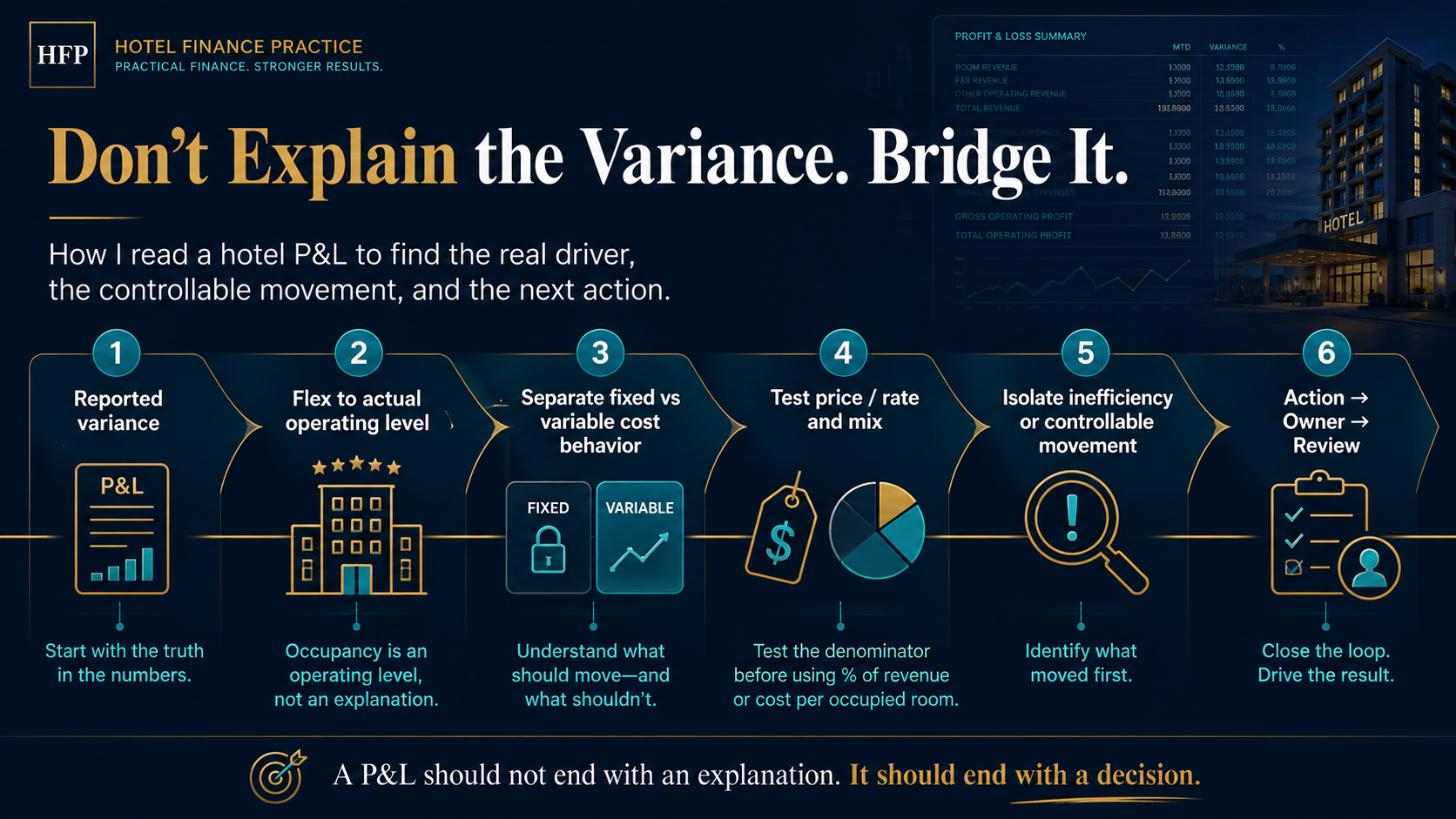
Figure 1. From reported variance to a management decision.
The P&L does not need a narrator
Consider a typical monthly discussion: housekeeping expenses are above budget because occupancy was higher; food cost increased because supplier prices went up; payroll is adverse because business levels were higher; utilities increased because occupancy increased.
All of these statements may contain some truth. But none of them is sufficient analysis. Higher occupancy is not necessarily an explanation for an unfavorable expense variance. It is an operating condition that should have been expected to move certain costs.
If occupied rooms increase, I expect some guest supplies, linen, laundry, cleaning materials, and possibly labour to increase. The real question is: how much should the cost have increased for the additional workload, and how much did it actually increase? The difference between those two numbers is where the management conversation begins.
The same applies to supplier prices. If food prices increased, that may explain part of the food-cost movement, but it does not automatically explain all of it. We still need to ask what happened to covers, menu mix, portioning, yield, purchasing, waste, and inventory.
I have often found that an adverse variance gets explained by the easiest external factor available: occupancy was higher, prices went up, the exchange rate moved, or the market changed. Those factors matter, but they can also become a convenient way of explaining away the part of the variance that management could actually influence.
I prefer to ask: what moved first?
When I review a P&L, I am not trying to explain every line independently. I am trying to understand the operating story behind the statement. The first painful number is not necessarily where the problem started.
Suppose Rooms Revenue is on budget, but the business mix moved toward higher-cost OTA channels. Gross Rooms Revenue may look fine, but acquisition cost increases. Perhaps the replacement guest mix also spends less in the restaurants. F&B capture falls. Eventually GOP is below budget.
If I start the meeting at GOP, I see a profit problem. If I start at F&B, I may blame the outlets. If I trace what moved first, I may discover that the original movement was in commercial mix.
This is why I prefer to read the P&L as a connected sequence rather than as isolated account lines. The objective is not to make the review complicated. It is to stop the wrong department from defending a consequence rather than managing the cause.
One of the biggest mistakes is treating every expense the same way
I repeatedly see two convenient ratios used for almost everything: expense as a percentage of revenue and expense per occupied room. Both can be useful. Neither is automatically the correct way to understand an expense.
The denominator should follow the economic behaviour of the cost, not the convenience of the spreadsheet. Guest supplies may reasonably follow occupied rooms. Laundry may follow occupied rooms or room turns. OTA commissions follow the value or basis defined by the channel agreement. Food consumption follows covers, product mix, and purchasing economics.
Utilities may contain a fixed base load, an occupancy-related component, a tariff movement, and an efficiency component. Software licences may hardly change at all when occupancy changes. Security may behave like a step cost if an additional post becomes necessary after a certain level of activity.
If I divide all of these expenses by occupied rooms, I can calculate a number. That does not mean I have learned anything useful. Cost behaviour and the relevant operating driver have to come first.
Higher occupancy should lead to a flexed expectation, not an excuse
Suppose the hotel budgeted 1,000 occupied rooms and actually sold 1,200. A variable expense budgeted at $10 per occupied room would have been $10,000. At the actual operating level, I would expect approximately $12,000 before considering other changes.
If actual expenditure was $14,000, saying "expenses are $4,000 above budget because occupancy was higher" does not tell me enough. About $2,000 may be explained by additional volume. The remaining $2,000 still needs to be investigated.
- Price or rate changes.
- Guest, room, product, or channel mix.
- Inefficient consumption or waste.
- Productivity or scheduling.
- A fixed, step, or contract-driven component.
- Timing or classification.
- Another supported structural or one-off factor. Instead of asking, "Why are we over budget?" I prefer to ask: "What should this expense have been at the actual operating level, and what explains the remaining difference?" That small change in the question produces a completely different quality of management discussion.
Percentage of revenue can create the same problem
Suppose payroll increases by 3%, but hotel revenue falls by 10%. Payroll as a percentage of revenue deteriorates significantly. Does that prove payroll productivity deteriorated? Not necessarily.
The hotel may still need minimum reception coverage, engineering presence, security, kitchen leadership, and other fixed staffing positions. Wage rates may have increased. Business mix may have changed. Hours may genuinely have become inefficient. The percentage alone cannot tell us which one occurred.
Likewise, a cost percentage can improve simply because revenue increased, even if management did nothing differently. This is why I use percentages as signals, not verdicts. The question is always: what operating activity should this cost follow?
I try to break the variance into components
For a material expense, I normally want to understand the following movements separately:
- Volume or activity - did we sell more rooms, serve more covers, hold more events, or perform more work?
- Price or rate - did supplier prices, wages, tariffs, or contract rates change?
- Mix - did the type of guest, room, product, channel, or event change?
- Cost behaviour - is part of the expense fixed, mixed, step-fixed, or contractually committed?
- Productivity or efficiency - did we use more labour, material, energy, or other resources than the workload justified?
- Timing or classification - did an invoice, accrual, mapping, or accounting treatment move the reported result?
- Structural or one-off movement - did a contract, asset issue, policy decision, or unusual event change the cost base? Not every line needs all seven analyses. The objective is not to create another enormous spreadsheet. The objective is to separate the part management could reasonably expect from the part management needs to investigate.
This is where P&L analysis becomes management
Once the movement is properly separated, accountability becomes much clearer. If the issue is supplier price, Procurement may need to renegotiate, source alternatives, or work with the operation on specification. If the issue is consumption, the department manager may need to address waste or operating practice. If it is labour productivity, the question may be scheduling, deployment, or process design.
If it is a fixed contract, telling the department to "control the cost" next month may achieve nothing. The action may need to happen at the next renewal date. If the issue is occupancy volume and the cost flexed exactly as expected, perhaps there is no corrective action at all.
Not every unfavorable variance is bad management.
A higher expense can support profitable additional business. The purpose of analysis is not to find somebody to blame. It is to identify the part of the result that can actually be changed.
I want every major variance to finish with an action
This is where many P&L meetings stop too early. We have explained the variance. Everybody nods. Then somebody says, "We will monitor it next month." For me, that is incomplete.
If we have identified a material controllable movement, I want to know:
- Who owns the lever?
- What are they going to change?
- What must they protect while changing it?
- When will we review the result?
- What evidence will tell us whether the action worked? "Control utilities" is not an action. A better action would be to separate base load, tariff, and occupancy-related consumption, investigate the unexplained usage movement, and report the revised trend at a defined review point.
"Reduce payroll" is not an action either. A better response is to review staffing hours against the actual workload, identify whether excess hours are workload-driven or scheduling-driven, and then change the deployment where management can influence it.
The four questions I would rather hear
If I had to simplify the entire review into four questions, I would use these:
1. What moved?
Not every number. The material movement.
2. Why did it move?
Separate activity, price, mix, cost behaviour, productivity, timing, and structural factors rather than giving one convenient explanation.
3. What part can we influence?
Distinguish external or committed movement from genuine management opportunity.
4. What are we going to do about it?
Name the action, owner, and review point.
That, for me, is the purpose of reading the hotel P&L. It is not to move from the first line to the last line and prove that Finance knows what every number means. It is to identify where the business changed, understand the economics behind that change, and decide what management should do while there is still time to influence the next result.
A P&L should not end with an explanation. It should end with a decision.
Further reading
This article draws on the practical methods developed in Hotel Operations Financial Playbook, particularly Chapter 3 (Reading Your P&L Without Flinching), Chapter 5 (Costs Do Not All Behave the Same), and Chapter 6 (Flash, Forecast, Variance, and Action). The detailed expense-driver methodology is also developed in Hotel Budgeting and Forecasting in Practice, particularly the chapters on expense architecture and cost control.
Frequently Asked Questions
Should every hotel expense be analysed per occupied room?
No. Per-occupied-room analysis is useful only when occupied rooms are a meaningful driver of the cost. Fixed, mixed, step, and contract-driven expenses should be analysed according to their actual cost behaviour.
How should managers explain an adverse hotel expense variance?
Start with the relevant operating driver, flex the expected cost to the actual operating level, and then separate volume, price, mix, productivity, timing, and structural effects. The remaining controllable component should be linked to a specific management action.
Is percentage-of-revenue analysis enough for hotel expenses?
No. It is a useful signal, but not a complete explanation. The ratio can move because the expense changed, revenue changed, or both. The correct analysis tests the economic driver of the cost before drawing a conclusion.
What makes a hotel P&L review actionable?
The review should end with a clear action, a named owner, the expected effect, and a defined review point. Otherwise the same variance can simply be explained again next month without corrective action.
Final management check
Before closing the review, ask one question: if the same variance appears next month, will we know whether the agreed action worked? If the answer is no, the analysis has not yet been converted into a measurable management response.
Management takeaways
- Do not narrate the P&L line by line; identify the material movement and what moved first.
- Higher occupancy is an operating level, not a complete explanation for an adverse cost variance.
- Flex the expected cost to actual activity before isolating price, mix, productivity, timing and structural effects.
- Match the denominator to the economic driver instead of applying percentage of revenue or cost per occupied room to every expense.
- Finish every material controllable variance with a specific action, named owner and review point.
Key concepts
- hotel P&L analysis
- variance analysis
- operating level
- flexed expectation
- cost behaviour
- fixed and variable costs
- price and mix variance
- productivity variance
- controllable movement
- management action