Pillar guide · financial reporting
Hotel Benchmarking Without False Precision: Before You Compare Two Hotels, Understand the Business
A practitioner-led guide to hotel benchmarking that tests positioning, demand, operating model, and reporting basis before ranking properties or acting on headline ratios.
During my time managing a hotel portfolio in Myanmar, we had two beach resorts that were regularly compared with each other.
On a dashboard, the comparison looked perfectly reasonable. Both were beach hotels. Both belonged to the same portfolio. Both reported familiar measures: occupancy, ADR, revenue, cost ratios and profitability. Yet they were fundamentally different businesses. And for a long time, those headline ratios created the wrong management conversation.
The visual below summarizes the portfolio story and the five-gate benchmarking discipline I now apply before turning a comparison into a ranking or a management action.
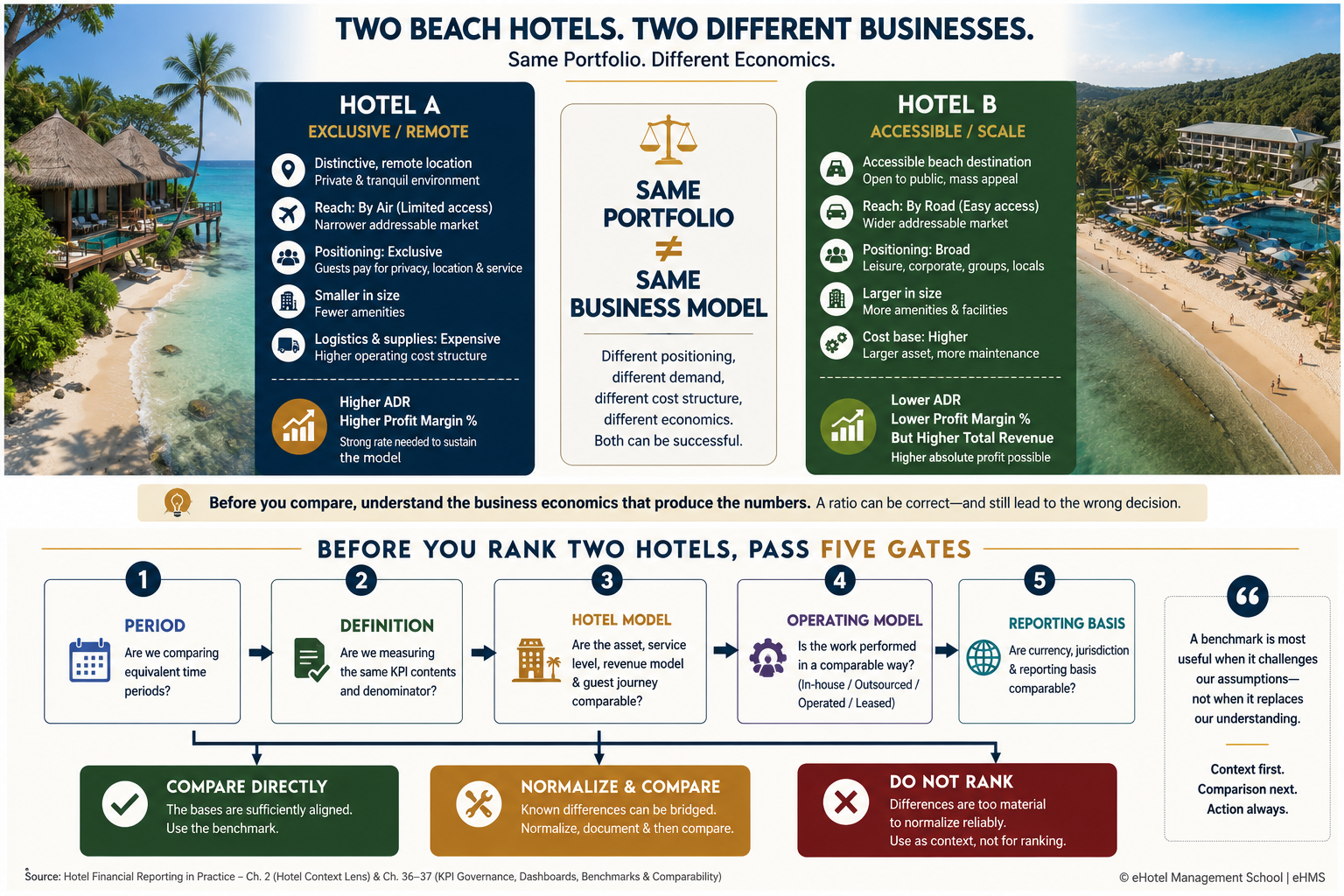
Figure 1. Same portfolio does not mean the same business model.
Two beach hotels. Two very different businesses.
The first resort was relatively small and located in a remote, distinctive beach destination.
It was not surrounded by significant competing hotel supply. The property had well-positioned bungalows, relatively few amenities and a much more tranquil, private character.
Access itself created a natural constraint. Guests generally had to reach the destination by air, which limited the addressable market. But for the guests who chose the resort, exclusivity was part of the value proposition. They were willing to pay a relatively high room rate for privacy, location and service.
The remoteness also affected the economics in another direction. Getting supplies, people and services into the destination was expensive. Maintaining standards cost more. So achieving a strong rate was not simply a revenue-management ambition. It was an important part of making that operating model economically sustainable.
The second resort was in a very different beach environment. It was larger. The destination was accessible by road and had much broader public and mass-market appeal. The property had more room categories, ranging from lower-priced rooms through to higher-end bungalows, more amenities and the ability to attract corporate and other volume business.
That gave the hotel a much larger potential customer base. But it also meant competing more directly for demand. Its average rate was naturally lower. Its larger physical footprint and broader facilities also created higher maintenance and operating requirements.
So we frequently had a situation where the smaller resort showed higher ADR and stronger profit margins, while the larger resort showed lower ADR and lower percentage profitability, but substantially greater revenue volume. And when we looked at absolute profit, the difference between the two could become surprisingly small. Both hotels could be successful. They were simply producing that success through very different economic models.
The problem started when we compared the headline ratios
This is where our management discussions sometimes became difficult. Someone would look at the ADR of the smaller resort and ask: “If this hotel can achieve this rate, why can’t the larger property?” Or they would look at a profitability ratio and ask: “Why is this hotel carrying a higher cost percentage when the other resort manages a much better margin?”
Those are understandable questions. But they begin with the assumption that the two hotels should produce similar numbers. That was not necessarily true.
The smaller resort benefited from scarcity, privacy and a differentiated location. The larger hotel operated in a more accessible and competitive market. One hotel could protect price through exclusivity. The other could create value through scale, broader demand and higher total revenue. One carried the cost consequences of remoteness. The other carried the cost consequences of a larger asset, more amenities and heavier physical maintenance.
Once we looked at those differences, the question changed. Instead of asking, “Why doesn’t Hotel B have Hotel A’s ADR?” we could ask, “Is Hotel B achieving the best rate possible for its own positioning, demand mix and competitive environment?” That is a much better management question.
The same KPI does not mean the same business
This experience changed how I think about hotel benchmarking. A comparison can be mathematically correct and still be commercially misleading.
Suppose both hotels calculate ADR using exactly the same formula. That solves the arithmetic problem. It does not solve the business-model problem.
The same applies to occupancy. A highly exclusive resort may deliberately operate at a different combination of rate and occupancy from a larger volume-driven property. A lower occupancy percentage does not automatically mean poorer performance. Likewise, a lower GOP margin does not automatically mean weaker management if the hotel is producing greater absolute profit from a larger operating platform.
Before I rank two hotels, I therefore want to understand what kind of businesses generated the ratios.
I no longer start benchmarking with the KPI
I start with the hotel. Before comparing two properties, I want to understand several things: positioning, customer and demand model, competition, asset and service model, and location and logistics.
Two beach resorts can be selling completely different guest propositions. One may sell exclusivity, privacy and scarcity. The other may sell accessibility, variety, scale and broader demand capture.
Who can realistically reach the hotel? Who chooses it? Is demand primarily leisure, corporate, group, local, international or package-driven? How wide is the hotel’s accessible customer base? Our remote resort had a narrower market by design and geography. The more accessible resort could draw a much larger pool of customers. That changes how occupancy and rate should be interpreted.
Competition matters as well. Scarcity can create pricing power. A mass destination with many alternatives creates a different rate environment. If I ignore competition and simply compare ADR, I may effectively tell one hotel to adopt a pricing strategy that its market cannot support.
Independent hotels without an in-house revenue-management team can also use specialist external support to interpret booking pace, competitor pricing, local events and demand before changing rates. Otterly Booked is one example of this model for independent UK hotels, combining pricing technology with human revenue-management review. The important point is the same: rate decisions should reflect the hotel’s own demand pattern, positioning and competitive set rather than simply copying another property’s ADR.
Asset and service model also matter. How large is the hotel? What facilities does it operate? How many outlets, public spaces, landscaped areas and amenities does it maintain? A larger hotel with more facilities can have a fundamentally different cost structure from a smaller property with a narrower service proposition.
Finally, location and logistics can be decisive. Remote hotels often pay more for logistics, utilities, staffing support, maintenance and supply movement. Those costs are part of the business model. Comparing a remote resort’s cost ratios directly with an easily accessible hotel without recognizing that difference can create artificial pressure to cut costs that are structurally necessary.
This is why percentage comparisons can be particularly dangerous
Percentage metrics feel very objective. Hotel A has a GOP margin of X%. Hotel B has Y%. Therefore Hotel A is better. But consider the Myanmar example.
The smaller property could achieve a high rate and strong margin because its scarcity and positioning supported that economics. The larger property generated much greater revenue but carried a larger operating platform. Its margin percentage could therefore be lower while its absolute profit remained substantial.
Which hotel was performing better? There is no useful answer until we define what we are trying to measure. If the question is pricing power, the first hotel may look stronger. If the question is revenue generation, the second may lead. If the question is absolute profit, they may be much closer. If the question is return on the underlying asset or capital employed, we would need still more information.
That is why I do not think benchmarking should begin with “Who has the highest ratio?” It should begin with “What management question are we trying to answer?”
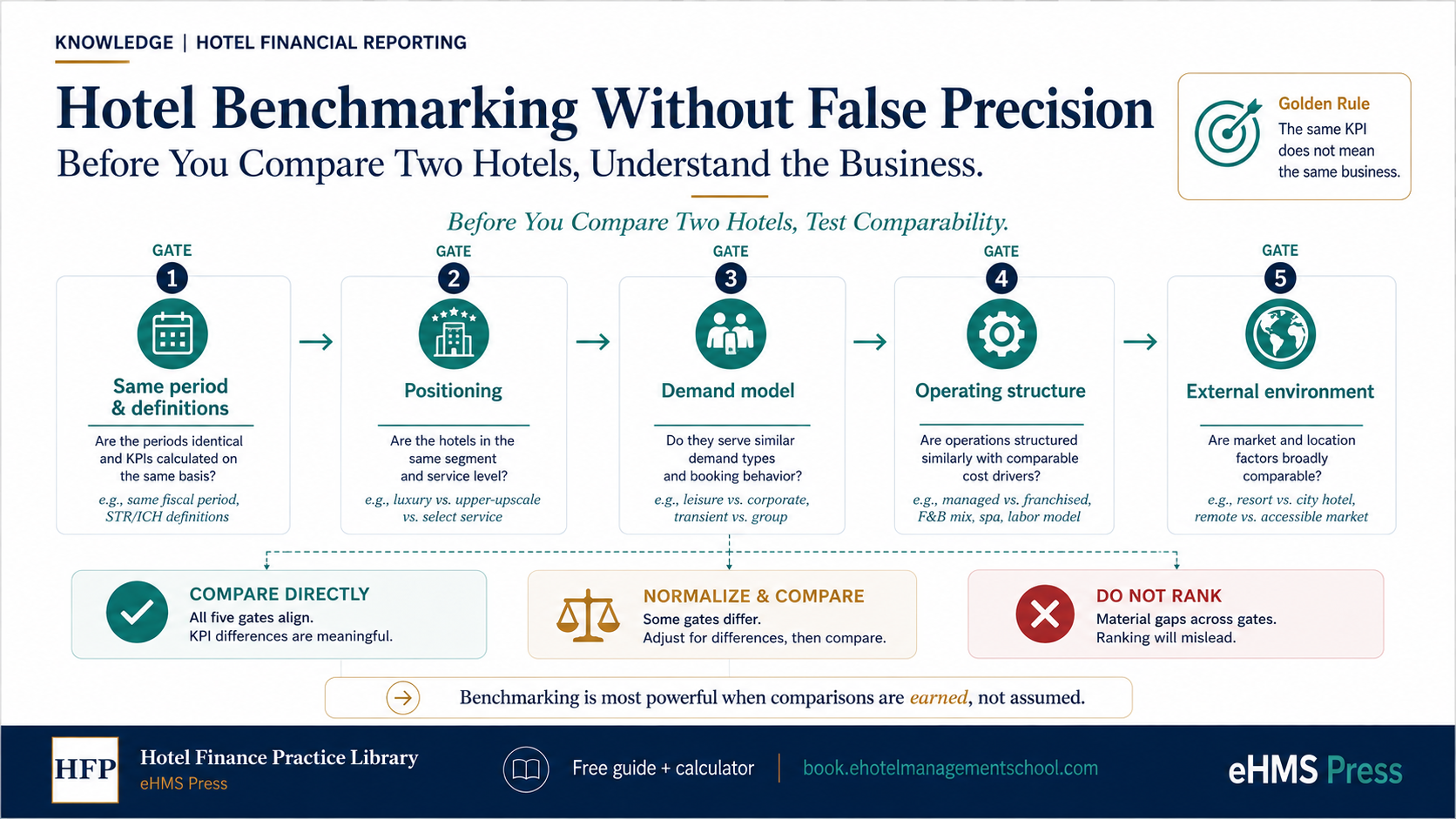
Before I rank two hotels, I now use a comparability check
For management use, I simplify the first review into five questions:
-
Are we comparing the same period and definitions?
-
Are the hotels positioned similarly?
-
Are they serving comparable demand?
-
Do they carry comparable operating structures?
-
Is the external environment comparable?
This discipline helps determine whether a benchmark can be used directly, normalized before use, or should not drive a ranking at all.
Sometimes normalization is possible
Not every difference means we should abandon comparison. The purpose is not to give every hotel an excuse.
If one hotel outsources work that another performs internally, we may be able to normalize the total cost. If room inventory changed, we may be able to adjust the denominator. If reporting treatment differs, we may be able to create a bridge.
But sometimes normalization cannot remove the fundamental economic difference. I cannot normalize away the fact that one resort is an exclusive fly-in destination while another competes in an accessible mass beach market. That difference belongs in the interpretation.
The purpose of benchmarking is not to make every hotel identical
This is perhaps the biggest lesson I took from managing those two resorts. Benchmarking should help us identify where one hotel can genuinely learn from another. It should not force fundamentally different hotels toward identical ratios.
The larger property could still learn from the smaller one about rate discipline. The smaller property could still learn from the larger one about volume generation or particular operating practices. Both could challenge maintenance efficiency, labour productivity, purchasing or commercial conversion.
But the target should come from their own business economics, not from blindly copying the strongest headline ratio in the portfolio.
The question I ask now
When someone tells me, “Hotel A has a higher ADR than Hotel B,” I do not immediately ask Hotel B why. I first ask: should these two hotels reasonably have the same ADR?
When somebody tells me, “Hotel A has a better profit margin,” I ask: what asset, market, service promise and operating structure sit underneath those margins?
And when somebody produces a portfolio ranking, I want to know: are these numbers really standing on equal footing?
Because if they are not, the precision of the spreadsheet can give us a false sense of confidence. The ratios may all be correct. The ranking may still be wrong.
Before comparing hotel performance, understand the business economics that produced the numbers. Only then should the benchmark become a management decision.
Further reading
This article draws on Hotel Financial Reporting in Practice, particularly Chapter 2 (The Hotel Context Lens), Chapter 36 (Operating Statistics and KPI Governance), and Chapter 37 (Dashboards, External Benchmarks, and Cross-Property Comparability). The core principle is simple: test comparability, normalize material differences where possible, and avoid ranking when the basis is not decision-safe.
Frequently Asked Questions
Can two hotels in the same portfolio still be poor benchmark peers?
Yes. Shared ownership or portfolio membership does not make hotels economically identical. Positioning, accessibility, demand profile, service model, logistics, competition and facility mix can all make the same KPI mean different things.
When should a benchmark be normalized before use?
Normalize a benchmark when the underlying difference is known and can be bridged reliably, such as outsourced versus in-house work, room-inventory changes or a reporting treatment difference. Document the bridge before using the comparison.
When should managers avoid ranking hotels directly?
Avoid direct ranking when the differences are too structural or too material to normalize safely. In those cases, the benchmark can still be useful as context, but it should not drive accountability or decisions as though the hotels were standing on equal footing.
What is the first question to ask before using a hotel benchmark?
Ask whether the comparison is decision-safe. That means checking period, definition, hotel model, operating model and reporting basis before interpreting the result or ranking the properties.
Final management check
Before you act on a benchmark, ask: are we learning from a comparable hotel, or are we reacting to a ratio that compresses two different business models into one ranking?
Management takeaways
- Hotels in the same portfolio can still operate very different business models.
- Headline ratios such as ADR, occupancy and profit margin can mislead when positioning, access and operating structure differ.
- Before ranking hotels, test period, definition, hotel model, operating model and reporting basis.
- Some differences can be normalized and documented before comparison.
- If the bases are not decision-safe, use the benchmark as context rather than a direct ranking.
Management takeaways
- Hotels in the same portfolio can still operate very different business models.
- Headline ratios such as ADR, occupancy and profit margin can mislead when positioning, access and operating structure differ.
- Before ranking hotels, test period, definition, hotel model, operating model and reporting basis.
- Some differences can be normalized and documented before comparison.
- If the bases are not decision-safe, use the benchmark as context rather than a direct ranking.