Hotel management question
What Is GOP in a Hotel? Departmental Profit vs GOP vs EBITDA vs Net Profit
Understand the hotel profit ladder from Departmental Profit through GOP, EBITDA and Net Profit, including what each level contains, what it is useful for and who primarily controls or influences it.
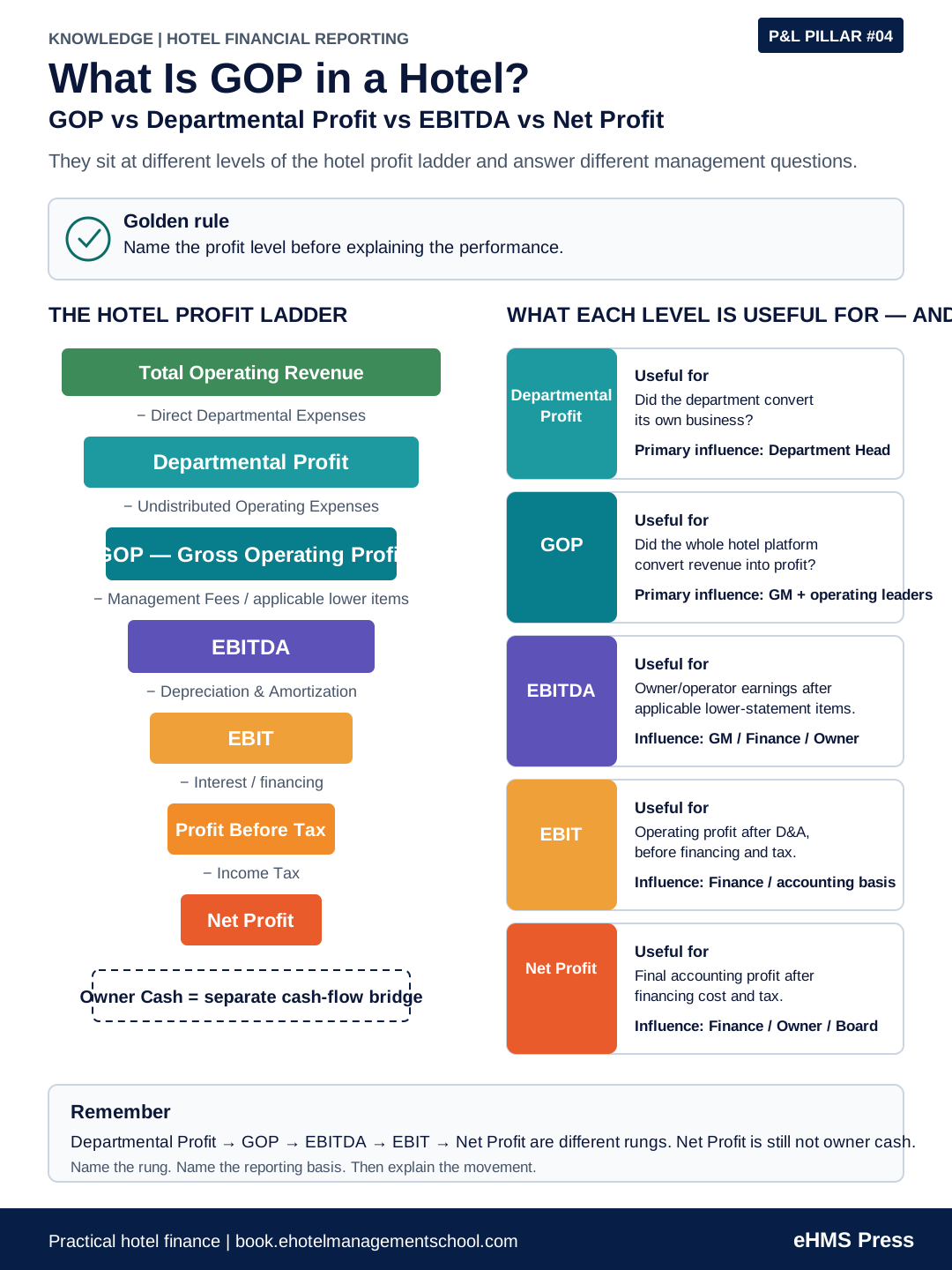
Departmental Profit, GOP, EBITDA and Net Profit are different levels of the hotel performance ladder. Departmental Profit tests a revenue-producing department after its direct costs; GOP tests the whole hotel operating platform after undistributed expenses; EBITDA takes the analysis through the applicable lower property and contractual layer before interest, tax, depreciation and amortization; and Net Profit is the accounting result after financing, depreciation/amortization and tax. Name the profit level before explaining the performance.
The hotel profit ladder
The visual above gives the management map. The exact chart of accounts and placement of particular items can differ according to the approved hotel reporting basis, operator/owner policy, management agreement and external accounting requirements.
A simplified ladder is:
Total Operating Revenue
↓ Direct Departmental Expenses
Departmental Profit
↓ Undistributed Operating Expenses
GOP — Gross Operating Profit
↓ Management Fees and applicable lower-statement items
EBITDA
↓ Depreciation and Amortization
EBIT / applicable operating-profit bridge
↓ Interest and Financing Items
Profit Before Tax
↓ Income Tax Expense
Net Profit / Net Income
And then there is another question: Owner Cash, which requires a separate cash and financing bridge.
The four profit levels in one view
| Profit level | What it broadly consists of | What it is most useful for | Primary control or influence |
|---|---|---|---|
| Departmental Profit | Department revenue less direct departmental expenses | Tests whether Rooms, F&B or another operated department converted its own business | Department Head, with GM oversight |
| GOP | Total Departmental Profit less hotel-wide undistributed operating expenses | Tests whether the full hotel operating platform converted revenue into operating profit | GM, supported by Department Heads and functional leaders |
| EBITDA | GOP adjusted through management fees and applicable lower-statement/nonoperating items under the stated basis | Owner/operator earnings analysis, property comparison and some financing or investment analysis | GM and Finance influence the bridge; owner, contract and property items increasingly matter |
| Net Profit | Accounting result after depreciation/amortization, financing costs and income tax under the governing basis | Understanding final accounting profitability | Finance/Controller, owner finance, board, tax and accounting stakeholders |
The important distinction is between control and influence. A Department Head may directly influence payroll, productivity, product cost or departmental supplies but normally cannot control property tax, financing cost, depreciation policy or income tax.
1. Departmental Profit — did the department convert its own business?
Conceptually:
Department Revenue − Direct Departmental Expenses = Departmental Profit
For Rooms, direct expenses can include direct payroll, guest supplies, laundry, commissions and acquisition costs, contract services and other direct operating expenses. For F&B, the direct economics can also include food and beverage product cost, kitchen and service payroll, operating supplies and casual labour.
The management question is:
Did this revenue-producing department retain the contribution expected from the business it generated?
A department can grow revenue while conversion gets weaker if channel cost, labour intensity, product mix or direct operating expense rises faster than revenue.
Who primarily influences Departmental Profit?
Usually the Department Head has the primary operating influence, with GM oversight and Finance providing validation, reporting and diagnostic support. Commercial decisions can also affect departmental economics through rate, segment, channel mix and acquisition cost.
Departmental Profit is therefore not an accounting number owned only by Finance. It is an operating result.
2. GOP — did the whole hotel operating platform convert the revenue?
The hotel also needs a shared support platform. Depending on the approved reporting structure, undistributed operating expenses can include areas such as Administrative & General, Information and Telecommunications Systems, Sales & Marketing, Property Operation & Maintenance, and Energy, Water & Waste.
Conceptually:
Total Departmental Profit − Undistributed Operating Expenses = GOP
GOP asks:
After operating the revenue departments and supporting the hotel-wide platform, how much operating profit did the property retain?
Who primarily influences GOP?
The GM has the broadest operating influence because GOP combines revenue performance, departmental economics, support-function costs, productivity, commercial choices and operating discipline. Department Heads influence the contribution feeding into GOP. Support-function leaders influence their respective undistributed cost areas. Finance ensures completeness, classification, accrual discipline, reconciliation and consistent interpretation.
Finance helps interpret GOP but does not operationally own every cost producing it.
Why Departmental Profit can improve while GOP falls
Suppose Rooms and F&B both improve their direct Departmental Profit, but energy, IT, Sales & Marketing or property-maintenance costs rise materially. Departmental performance can improve while GOP deteriorates.
There is no contradiction. The additional cost occurred between the two rungs.
That is why the practical P&L question is not simply, “Which line is adverse?” but “Where did the movement first occur?”
Read the related guide: How to Read a Hotel P&L Without Jumping to the Wrong Cause.
3. EBITDA — what remains after the lower hotel/property layer?
EBITDA stands for Earnings Before Interest, Taxes, Depreciation and Amortization.
In the hotel-management reporting bridge used in the eHMS material, additional items can sit between GOP and EBITDA, including management fees and applicable property or nonoperating items under the stated reporting basis.
The useful question becomes:
What earnings remain after the applicable hotel/property and contractual layers, before financing, tax, depreciation and amortization?
What is EBITDA useful for?
Depending on the reporting context, EBITDA can help owners understand property earnings, support operator/owner performance review, assist investment analysis and support financing analysis where the definition matches the governing agreement.
But the definition matters. Hotel-management EBITDA, adjusted corporate EBITDA and lender covenant EBITDA should not be assumed to be identical.
Before comparing two EBITDA numbers, ask:
EBITDA according to which definition?
Who primarily influences EBITDA?
Hotel operations still influence EBITDA through GOP, but below GOP more items may be driven by management agreements, property ownership, lease structures, insurance, property obligations and owner policy. The GM still influences the operating base; Finance owns more of the reconciliation and classification bridge; and the Owner or Asset Manager increasingly influences property, contract and capital decisions.
4. Where EBIT fits
A simplified analytical bridge is:
EBITDA − Depreciation − Amortization = EBIT
EBIT shows earnings after recognizing depreciation and amortization but before financing and income tax.
Do not assume hotel GOP is automatically the same thing as statutory or IFRS/GAAP operating profit. Hotel management reporting and general-purpose accounting serve different purposes and need to be reconciled deliberately.
5. Net Profit — what accounting profit remains?
A simplified bridge is:
EBITDA
− Depreciation
− Amortization
= EBIT
− Interest and Financing Costs
= Profit Before Tax
− Income Tax Expense
= Net Profit
Net Profit asks:
What accounting profit remains after the relevant operating, asset-use, financing and tax effects have been recognized?
What is Net Profit useful for?
Net Profit helps owners, boards and Finance understand full-period accounting profitability, financing burden, asset-use charges, tax effect and final entity/property accounting performance.
But Net Profit is not simply the GM's operating performance score. The GM influences it significantly through GOP, but usually does not directly control every financing, depreciation or tax item below that level.
Who primarily controls or influences each rung?
| Role | Primary financial influence |
|---|---|
| Rooms Leader | Rooms revenue conversion, labour productivity, supplies and direct operating expenses |
| F&B Leader / Executive Chef | Revenue mix, product cost, staffing and kitchen/service productivity |
| Commercial / Revenue Leader | Rate, volume, segment mix, channel mix and acquisition economics |
| Engineering / POM | Maintenance and property operating cost |
| HR / A&G / IT / Sales & Marketing leaders | Relevant undistributed operating costs |
| General Manager | Overall hotel operating platform and therefore GOP |
| Financial Controller / Finance | Reporting integrity, reconciliation, accounting bridge, forecasting and interpretation |
| Owner / Asset Manager | Property-level obligations, capital structure, reserve/capital policy and owner economics |
| Board / Owner Finance / Tax / Auditors | Financing, tax and final accounting-profit governance |
The further down the statement we move, the less appropriate it becomes to treat every variance as an operating-department responsibility.
Worked example — one hotel, four correct profit numbers
The following is a synthetic teaching illustration, not a benchmark.
| Profit bridge | Amount |
|---|---|
| Total Operating Revenue | $10,000,000 |
| Less: Direct Departmental Expenses | ($3,800,000) |
| Departmental Profit | $6,200,000 |
| Less: Undistributed Operating Expenses | ($2,100,000) |
| GOP | $4,100,000 |
| Less: Management Fees | ($300,000) |
| Less: Applicable Nonoperating Expense | ($500,000) |
| EBITDA | $3,300,000 |
| Less: Depreciation | ($900,000) |
| Less: Amortization | ($400,000) |
| EBIT | $2,000,000 |
| Less: Interest and Financing Items | ($600,000) |
| Profit Before Tax | $1,400,000 |
| Less: Income Tax Expense | ($280,000) |
| Net Profit | $1,120,000 |
A Department Head can correctly say the revenue departments generated $6.2 million of Departmental Profit. The GM can correctly say the hotel generated $4.1 million of GOP. Finance can correctly say the bridge produced $3.3 million of EBITDA. The Board can correctly say the business reported $1.12 million of Net Profit.
Those statements describe different rungs of the same ladder.
Why GOP can improve while EBITDA falls
Hotel operations can improve while management fees, property taxes, insurance, rent or another supported lower-statement charge absorbs the gain. The right conclusion is not that GOP was misleading. It is that operating performance improved but value was absorbed at a lower statement layer.
Why EBITDA can improve while Net Profit falls
EBITDA can improve while depreciation, financing cost, interest or tax expense increases. Again, the two numbers answer different questions.
Net Profit is not owner cash
A hotel can report positive Net Profit and still have cash pressure because cash can also be affected by receivables, inventory, supplier payments, debt principal, capital expenditure, reserve funding, owner contributions or drawings, financing movements and timing differences.
The complete conceptual chain is:
Revenue → Departmental Profit → GOP → EBITDA → Net Profit → Owner Cash
But the final step requires a cash-flow bridge, not another P&L subtotal.
Which number should I use?
Use Departmental Profit when asking whether a revenue-producing department converted its own business efficiently.
Use GOP when asking whether the whole hotel operating platform converted total operating revenue into operating profit.
Use EBITDA when asking what the stated lower profit bridge shows before interest, tax, depreciation and amortization.
Use Net Profit when asking what accounting result remains after financing and tax.
Use cash flow when asking what money actually moved.
And if a lender asks for EBITDA or NOI, use the definition in the loan agreement rather than substituting a generic hotel measure.
Five common mistakes
- Saying “profit is down” without naming the level. Name the rung.
- Treating Departmental Profit and GOP as interchangeable. Departmental Profit has not yet absorbed the hotel's shared operating platform.
- Treating GOP and EBITDA as interchangeable. Management fees and applicable property/lower-statement items can sit between them.
- Treating EBITDA as Net Profit. EBITDA excludes financing, tax, depreciation and amortization.
- Treating Net Profit as cash. Accounting profit and cash movement are different measurements.
The management question changes as you move down the ladder
Departmental Profit: Did the department convert its business?
GOP: Did the whole hotel operating platform convert that business?
EBITDA: What remained after the applicable lower hotel/property layer?
Net Profit: What accounting profit remained after financing and tax?
Owner Cash: What cash can actually be funded, reinvested, used for debt or distributed?
Each is useful. None should replace the others.
Related practical resources
- How to Read a Hotel P&L Without Jumping to the Wrong Cause — identify where a variance started.
- What Is Hotel Flow-Through? Formula, Examples and How to Interpret It — see how revenue movement converts into GOP.
- Hotel Flow-Through & Flex Calculator — calculate your own flow-through.
- How I Read a Hotel P&L: Stop Narrating the Numbers and Find the Real Driver — use the broader P&L diagnostic method.
Source basis and professional-use note
This practical answer is based primarily on Hotel Financial Reporting in Practice, especially Chapter 4 The Operating Statement Ladder, Chapter 32 GOP Margin, Fixed Charges, and the EBITDA Bridge, and Chapter 34 USALI, US GAAP, IFRS, Statutory, Tax, and Lender Reporting Bridge.
The $10 million worked illustration is an eHMS synthetic teaching example created for this practical answer and its accompanying visual. It is not a hotel benchmark.
Exact USALI, statutory, IFRS/GAAP, tax, lender and management-agreement requirements can differ. The approved reporting structure and governing documents should control live property reporting.
Management takeaways
- Name the profit level before explaining the performance.
- Use Departmental Profit for department conversion and GOP for the whole hotel operating platform.
- Treat EBITDA as a defined lower-statement earnings measure, not as a synonym for GOP or cash.
- Use Net Profit for the final accounting result after financing and tax, but do not confuse it with owner cash.
- Match accountability to the rung: operating leaders influence the upper ladder; owner, finance, contract and accounting factors matter increasingly below GOP.
Key concepts
- hotel GOP
- Gross Operating Profit
- Departmental Profit
- EBITDA
- EBIT
- Net Profit
- hotel operating profit
- hotel P&L
- owner cash
- profit ladder
- hotel profitability