Pillar guide · ai commercial strategy
When AI Sends the Booking, Is It Still Direct?
As AI moves from travel discovery toward transaction, hotels need a more precise way to separate discovery control, booking ownership, acquisition economics, customer relationship and repeat-demand control.
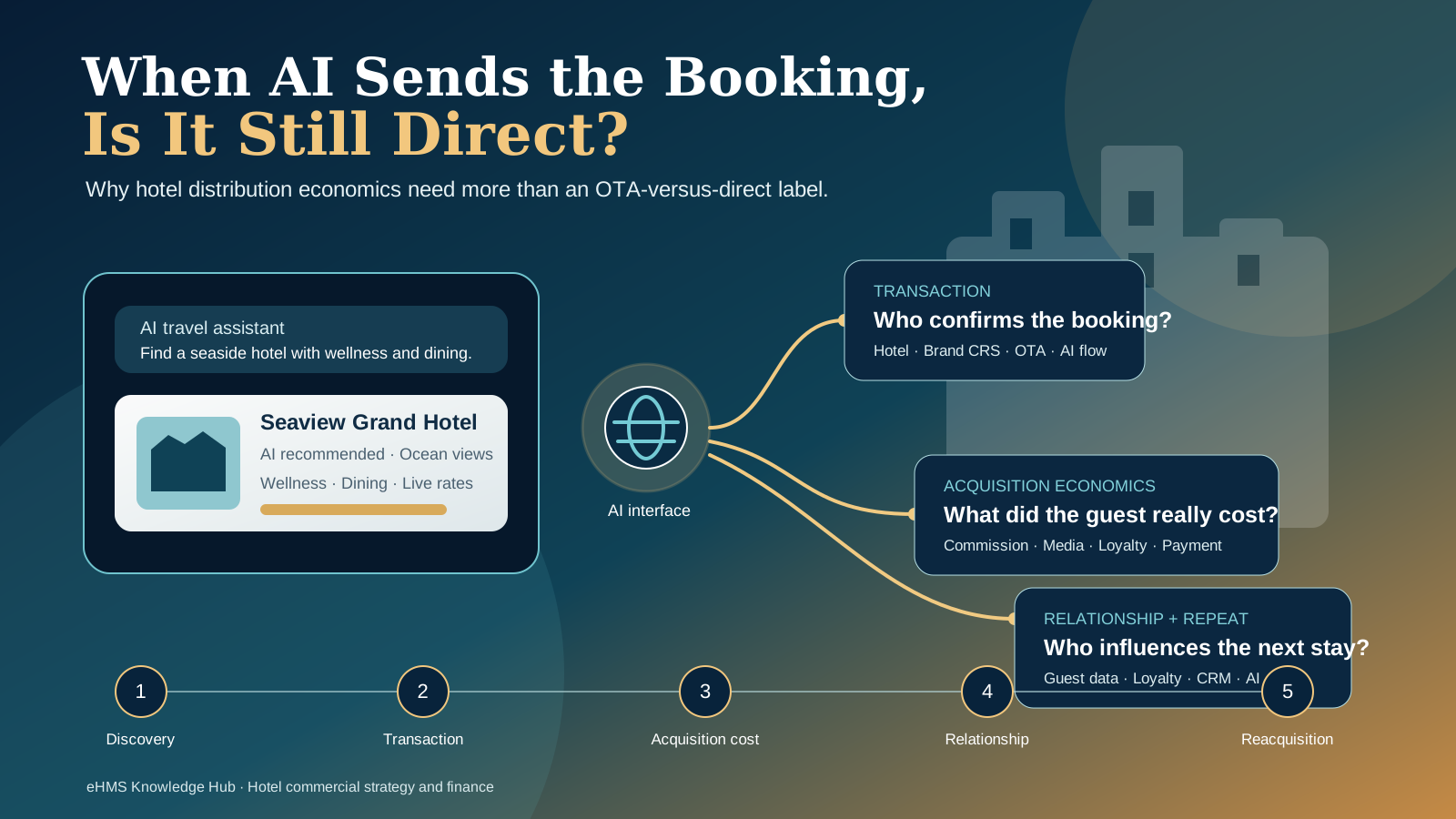
For years, hotel distribution conversations have been built around a familiar divide: direct versus intermediary.
A guest books through the hotel's website or booking engine and the reservation is treated as direct. A guest books through an OTA and the reservation is intermediated. The commercial conversation then turns to commissions, channel mix and how much business the hotel can shift toward direct.
That distinction is still useful.
But it is becoming less capable of explaining the whole customer journey.
Consider an increasingly realistic booking path. A traveller asks an AI assistant for a hotel. The AI interprets the requirements, searches available options, compares hotels, presents reviews and prices and recommends several properties. The traveller selects one and proceeds through the AI environment to make the reservation.
Now suppose the hotel itself remains merchant of record, receives the reservation and customer information, and services the booking.
Is that a direct booking?
Perhaps. But it may be direct in one dimension and intermediated in another.
That is becoming a management and financial question rather than merely a technology question.
AI is moving deeper into the booking journey
This is no longer solely a discussion about what AI might eventually do.
On 27 August 2026, Google announced hotel booking through AI Mode in Search. The feature is rolling out in English in the United States and allows travellers to discover hotels, compare options and choose "Continue on Google" where an integrated partner is available. Google's launch partners include hotel groups as well as Booking.com, Expedia, Hotels.com, Priceline and Trip.com. Google states that the hotel or booking platform involved remains merchant of record and handles customer service.
A second development is potentially more important for the longer-term distribution model.
Google has introduced Universal Commerce Protocol for Lodging, an open standard intended to support direct hotel reservations through AI surfaces. Google states that participating lodging providers can remain merchant of record, retain control of customer relationships and booking data, and distinguish bookings flowing through Google's AI surfaces from their own website or app. Google currently says it will adopt UCP to power its hotel-booking feature in AI Mode over the coming months.
That distinction matters.
The hotel can own the transaction. An AI platform can own the customer interface. Search, social, an OTA or some other platform may have influenced discovery before that. And acquiring the customer can still involve media, technology, loyalty, payments and other commercial costs.
Calling all of that simply direct may conceal more than it explains.
The booking channel and the discovery source are not the same thing
This problem did not begin with AI.
The eHMS approach to commercial analysis already separates customer segment, source market, discovery source and booking route. Search or social can generate awareness while a booking engine closes the reservation. A corporate guest can book through a GDS, email or brand platform. The same reservation can therefore carry several legitimate classifications.
This principle is also consistent with the wider eHMS room-demand framework: demand quality should not be judged from occupancy, ADR or a channel label alone.
The control rule is simple: preserve discovery source and booking route as separate fields. One blended "source" field weakens attribution, account value and channel-economics analysis.
AI makes that separation more important.
Instead of asking only:
What percentage of our bookings are direct?
management may increasingly need to ask:
Direct in what sense?
A proposed framework: The Five Layers of Booking Directness
The following is a proposed eHMS management framework. It is not an established industry classification.
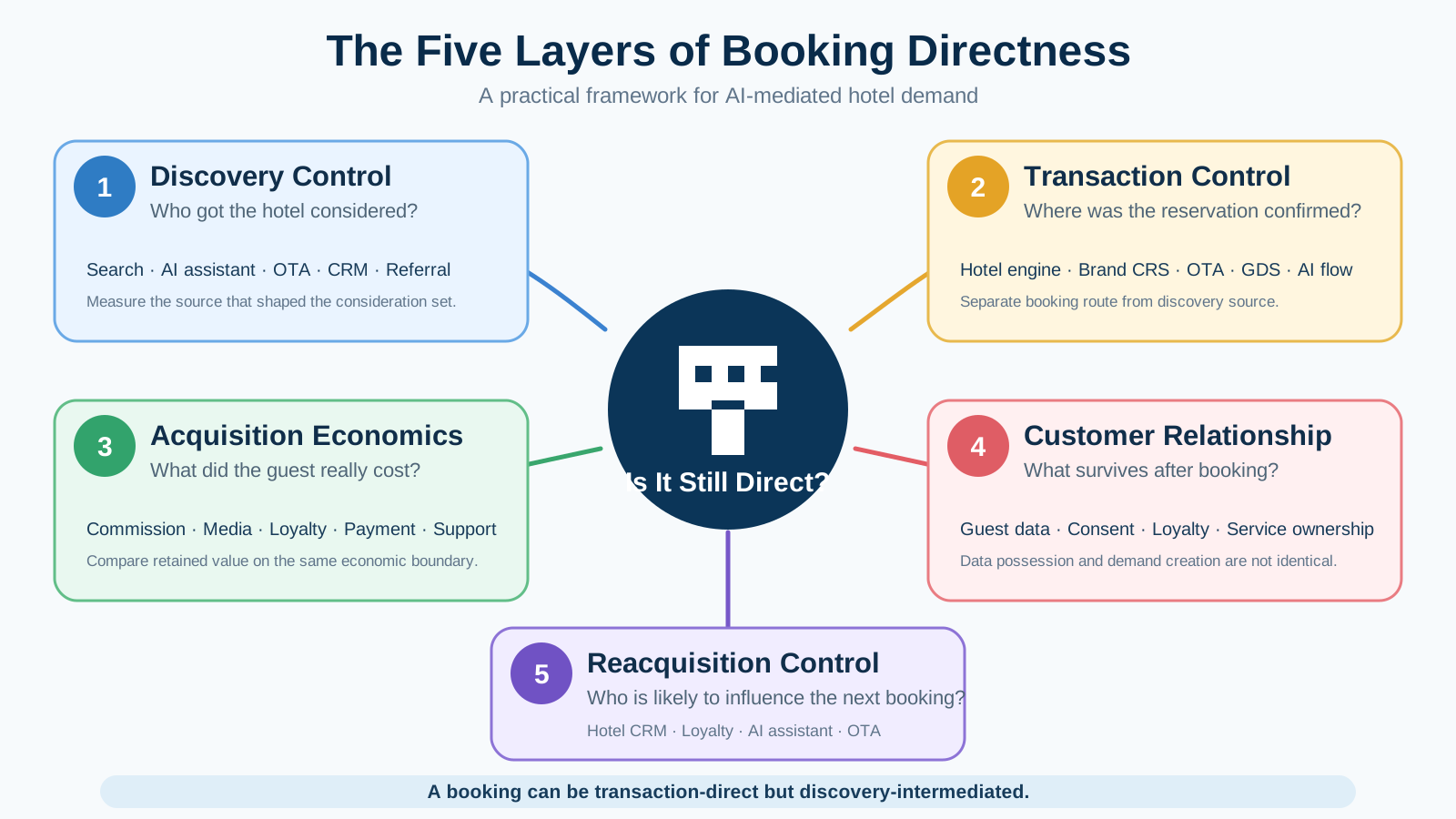
1. Discovery control — Who got the hotel considered?
Before asking where the transaction occurred, identify how the property entered the traveller's consideration set.
That may have happened through the hotel's own CRM, organic search, paid search, an OTA, metasearch, social media, an AI assistant, a loyalty ecosystem, a referral or an existing customer relationship.
This increasingly matters because the organisation controlling discovery can influence which properties are considered before the hotel has an opportunity to convert the guest.
Adobe's August 2026 research provides an indication of that shift. Adobe reported that traffic from AI sources to US travel websites increased 119% year over year in July 2026. Adobe defines this as users clicking from an AI source to a travel site; it should therefore be treated as AI-referred traffic, not evidence that those reservations were transacted inside AI.
PwC's 2026 US consumer research also found growing use of AI in travel shopping. PwC reported that 44% of respondents often or always used AI tools to compare travel prices and discounts, while one-third reported using AI agents or bots to book parts of their trips.
AI can therefore matter commercially before it becomes the booking channel.
2. Transaction control — Where did the commitment occur?
This is closest to the traditional definition of direct booking.
Where was the reservation actually confirmed?
Was it completed through the hotel's booking engine, a brand system, an OTA, GDS, travel intermediary or an AI-enabled booking flow?
Google's UCP model illustrates why this is becoming complicated. Google describes reservations taking place through its AI surface while the lodging provider can remain merchant of record and retain the customer relationship and data.
So a reservation could reasonably be described as:
Transaction-direct but discovery-intermediated.
That is more informative than forcing the entire customer journey into a single direct/indirect label.
3. Acquisition economics — What did the guest actually cost?
This is where Finance should become particularly interested.
The commercial question is not whether direct is inherently good or whether OTA demand is inherently weak. The useful comparison includes media, commission, reservation, loyalty, payment, benefits and relevant support cost alongside net rate, contribution, cancellation, ancillary value and displacement.
That same logic sits behind the eHMS distinction between gross Rooms revenue and analytical net Rooms value: a management view that helps compare demand after acquisition and support costs without replacing the hotel's formal accounting presentation.
This matters because an AI-mediated reservation may carry no traditional OTA commission and still require expenditure on paid acquisition, metasearch, loyalty benefits, direct-booking offers, payment processing, technology, content or other commercial infrastructure.
The relevant question is therefore not simply:
Did we avoid an OTA commission?
It is:
What value did the hotel retain after acquiring this demand?
A synthetic illustration
Consider two reservations that each produce $1,000 of gross room revenue.
The first comes through an OTA with $170 of attributable acquisition cost.
The second is classified as direct but carries $80 of attributable media cost, $40 of loyalty or offer cost, $25 of payment and technology cost and $35 of other attributable acquisition support.
The first has $170 of identified acquisition cost.
The second has $180.
These numbers are deliberately synthetic. They are not an industry benchmark and they do not demonstrate that OTA business is generally cheaper.
They demonstrate something narrower and more useful:
The booking label cannot determine the economics.
The result could just as easily run in the opposite direction. AI might introduce genuinely incremental demand at very low marginal acquisition cost while allowing the hotel to retain the transaction and customer relationship.
Management needs to measure rather than assume.
4. Customer relationship — What survives after the booking?
The fourth layer concerns what the hotel actually retains once the reservation exists.
Management should understand whether the hotel receives usable customer information, who handles amendments and cancellations, whether loyalty can be recognised, what communication permissions exist and who owns post-booking service.
Under Google's published UCP model, the lodging provider remains merchant of record and retains ownership of customer relationships and booking data. Google also notes that normal privacy and consent requirements continue to apply.
That is materially different from a distribution structure in which an intermediary controls more of the transaction or customer relationship.
But one distinction remains important:
Having customer data does not necessarily mean the hotel created the customer relationship.
A traveller may receive the hotel's confirmation and stay at the hotel while still perceiving the AI platform as the place where the purchase journey began.
That leads to the final layer.
5. Reacquisition control — Who is positioned to influence the next booking?
Hotels normally assess acquisition economics one reservation at a time.
The more strategic question may concern what happens after the stay.
Will the traveller return to the hotel's website? Respond to its CRM? Use the loyalty programme? Return to the same AI assistant and ask again? Use an OTA? Or choose another hotel that is recommended next time?
I would describe this as reacquisition dependence: a proposed management concept for evaluating how dependent the hotel remains on an external source to recreate future demand.
It should not be presented as a standardised KPI.
Its purpose is to force a useful question:
The hotel may have captured today's booking. Did it improve its position for tomorrow's booking?
A hotel could receive the customer's identity and still have to reacquire the same customer repeatedly through an external discovery environment.
Alternatively, the hotel might convert externally discovered demand into retained demand through experience, loyalty and post-stay engagement.
Those are economically different outcomes.
There is a strong counterargument: travellers may not be ready
The case for measuring AI-mediated demand should not turn into a prediction that AI will quickly dominate transactions.
Current evidence is mixed.
Expedia Group's April 2026 research, based on more than 5,700 adults across the United States, United Kingdom and India, found considerable willingness to use AI for travel discovery and planning but much greater caution around transactions. Sixty-eight percent preferred booking through trusted travel brands rather than AI chatbots or agents, and only 8% said they were comfortable booking through an AI platform.
Deloitte's 2026 summer-travel research nevertheless found growing adoption of generative AI for travel planning: 25% of surveyed US travellers in 2026 versus 15% in 2025.
These findings do not need to agree perfectly. They measure different populations and different behaviour.
The more useful interpretation is that AI can become important in discovery before consumers become comfortable delegating the transaction itself.
For hotels, that means distribution may change before the conventional booking-channel report shows much change at all.
Nor does AI mean the end of OTAs
Google's own rollout demonstrates why predictions about removing intermediaries should be treated cautiously.
Its AI Mode booking partners include hotel companies and major online travel businesses.
Traditional channel economics also remain material for independent hotels. Cloudbeds' 2026 State of Independent Lodging report reports a 63.4% OTA share and 36.6% direct share in its independent-hotel dataset. Those figures describe the Cloudbeds population and should not be treated as universal hotel-industry shares.
AI therefore does not necessarily eliminate intermediation.
It may change where intermediation occurs.
AI may send a customer to the hotel. It may send the customer to an OTA. A hotel may transact through an AI interface while remaining merchant of record. An OTA may itself become part of the infrastructure behind an AI-mediated booking.
Several of these models can coexist.
What should management change now?
The immediate requirement is not another dashboard showing an uncertain percentage of "AI bookings."
It is better commercial architecture.
A hotel distribution review should increasingly distinguish:
| Field | Management question |
|---|---|
| Customer segment | Who is the customer? |
| Discovery source | How did the hotel enter consideration? |
| Interface / recommendation source | Who controlled what the traveller saw? |
| Booking route | Where was the reservation confirmed? |
| Merchant of record | Who owned the transaction? |
| Acquisition economics | What did acquiring this demand cost? |
| Relationship position | What usable customer relationship remained? |
| Reacquisition dependence | Who is best positioned to influence the next booking? |
Commercial teams can improve the accuracy and machine-readability of property content, rates, policies and amenities.
Revenue teams can preserve discovery source separately from booking route.
Finance can build comparable acquisition-cost boundaries across channels without double counting expenditure.
Technology teams can understand which interfaces, integrations and data flows increasingly sit between demand and reservation.
Management can then observe whether externally discovered guests become genuinely retained customers.
For the broader boundary between AI capability and human judgement in hotel finance, see What I Have Learned Using AI in Hotel Finance.
Direct booking is not dead. The definition is becoming more demanding.
There is no need to abandon the term direct booking.
There is a need to stop asking it to describe the whole economics of the customer journey.
A reservation may be direct in transaction ownership but intermediated in discovery.
The hotel may retain customer data but not control the interface through which the guest chose it.
It may avoid OTA commission but incur material acquisition expenditure elsewhere.
And it may capture today's booking while remaining dependent on another platform to influence tomorrow's booking.
None of that makes AI-mediated demand inherently good or bad.
It means it should be measured more carefully.
So the next distribution discussion between the GM, commercial leader, revenue manager and CFO may need to go beyond:
How much of our business is direct?
The better questions are:
- Who created the demand?
- Who controlled the transaction?
- What did we really pay to acquire it?
- What customer relationship did we retain?
- Who is most likely to influence the next booking?
As AI moves further from travel inspiration toward transaction, those distinctions may become more useful than the channel label itself.
Sources and further reading
- Google — Book hotels with AI Mode in Search
- Google for Developers — Universal Commerce Protocol for Lodging FAQ
- Adobe — US consumers are embracing LLMs to make travel plans
- PwC — US Hospitality Directions: May 2026
- Expedia Group — The AI Trust Gap
- Deloitte — 2026 Summer Travel Survey
- Cloudbeds — 2026 State of Independent Lodging Report
Management takeaways
- Treat direct and intermediated as dimensions of a booking journey rather than one binary label.
- Preserve discovery source and booking route separately before interpreting channel performance.
- Compare channels on complete acquisition economics, not commission alone.
- Merchant-of-record and customer-data ownership do not automatically mean the hotel controlled discovery.
- Track whether externally discovered guests become retained demand or must be reacquired through another platform.